


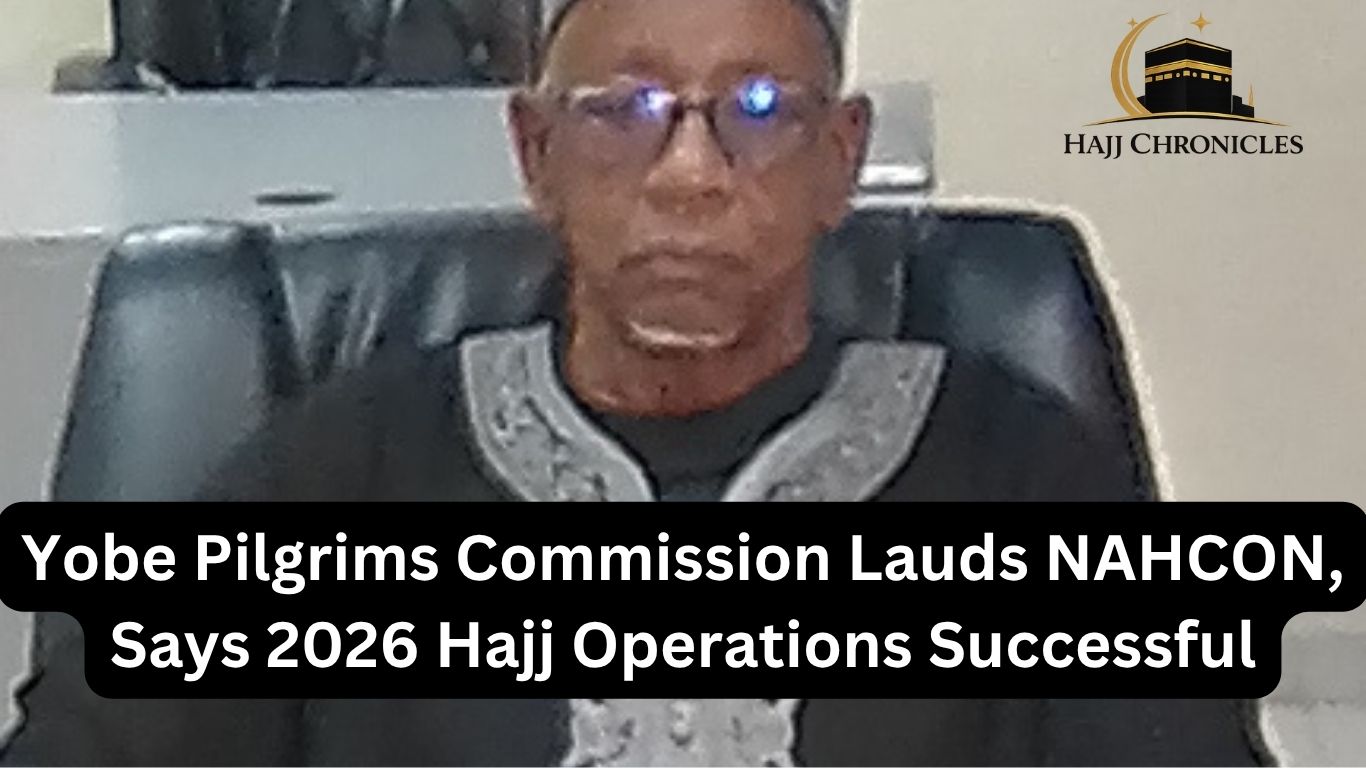
The Yobe State Pilgrims Commission has commended the National Hajj Commission of Nigeria (NAHCON), state pilgrims boards for what it described as the successful conduct of the 2026 Hajj exercise.
Speaking in an interview with Hajj Chronicles in Saudi Arabia, the Executive Chairman of the Yobe State Pilgrims Commission, Mai Ali Usman, said initial fears over possible challenges associated with the pilgrimage did not materialize, as all stakeholders worked collectively to ensure a smooth operation.
“Alhamdulillah, Allah has helped us. Together with NAHCON, all the states of pilgrims in Nigeria, we can confidently say that we have succeeded,” Mai Ali Usman stated.
The Yobe Pilgrims Commission Chairman disclosed that Yobe and Borno States were allocated Air Peace for the airlift of their pilgrims, noting that the airline adhered largely to the schedule earlier communicated to the states.
According to him, the pilgrims from both states were transported to and from the Kingdom of Saudi Arabia without major difficulties.
“Air Peace evacuated all our pilgrims in good time. The timetable given to us before departure was largely followed. Although there were some developments during the return journey, Yobe and Borno worked together harmoniously throughout the exercise,” he said.
On the implementation of the “first in, first out” policy adopted for the return airlift, Mai Ali Usman said Borno State commenced the return operation ahead of Yobe, adding that the arrangement was well coordinated and satisfactory.
The Commission also highlighted the extensive sensitization programme carried out to ensure that pilgrims performed their religious obligations in accordance with Islamic teachings.
Mai Ali Usman explained that immediately after receiving directives from NAHCON, the Commission convened meetings involving fare collectors from all the 17 local government areas of the state, alongside officials at the headquarters, to strategize on pilgrims’ enlightenment.
He said each local government established a standing committee responsible for sensitizing pilgrims, while the Commission also engaged resident and visiting Islamic scholars to provide lectures on Hajj rites and other relevant issues.
“We invited various ulama to educate the pilgrims. We also involved security personnel and medical officials to enlighten them on their respective responsibilities before departure,” he said.
According to Mai Ali Usman, the sensitization exercise continued in Saudi Arabia, with Islamic scholars assigned to various pilgrims’ accommodations to provide continuous guidance throughout the pilgrimage.
He added that all fare collectors remained with their pilgrims during the exercise to ensure close supervision and prompt response to their needs.
The Executive Chairman further disclosed that the state deployed a medical team to Saudi Arabia and established clinics to cater for the healthcare needs of pilgrims.
He said two ambulances were also provided to facilitate the evacuation of sick pilgrims to hospitals whenever necessary.
Mai Ali Usman expressed satisfaction with the overall health situation of Yobe pilgrims, noting that the state did not record any serious health challenges during the Hajj exercise.
He attributed the success recorded during the pilgrimage to effective planning, sustained sensitization and the collective efforts of all stakeholders involved in the operation.